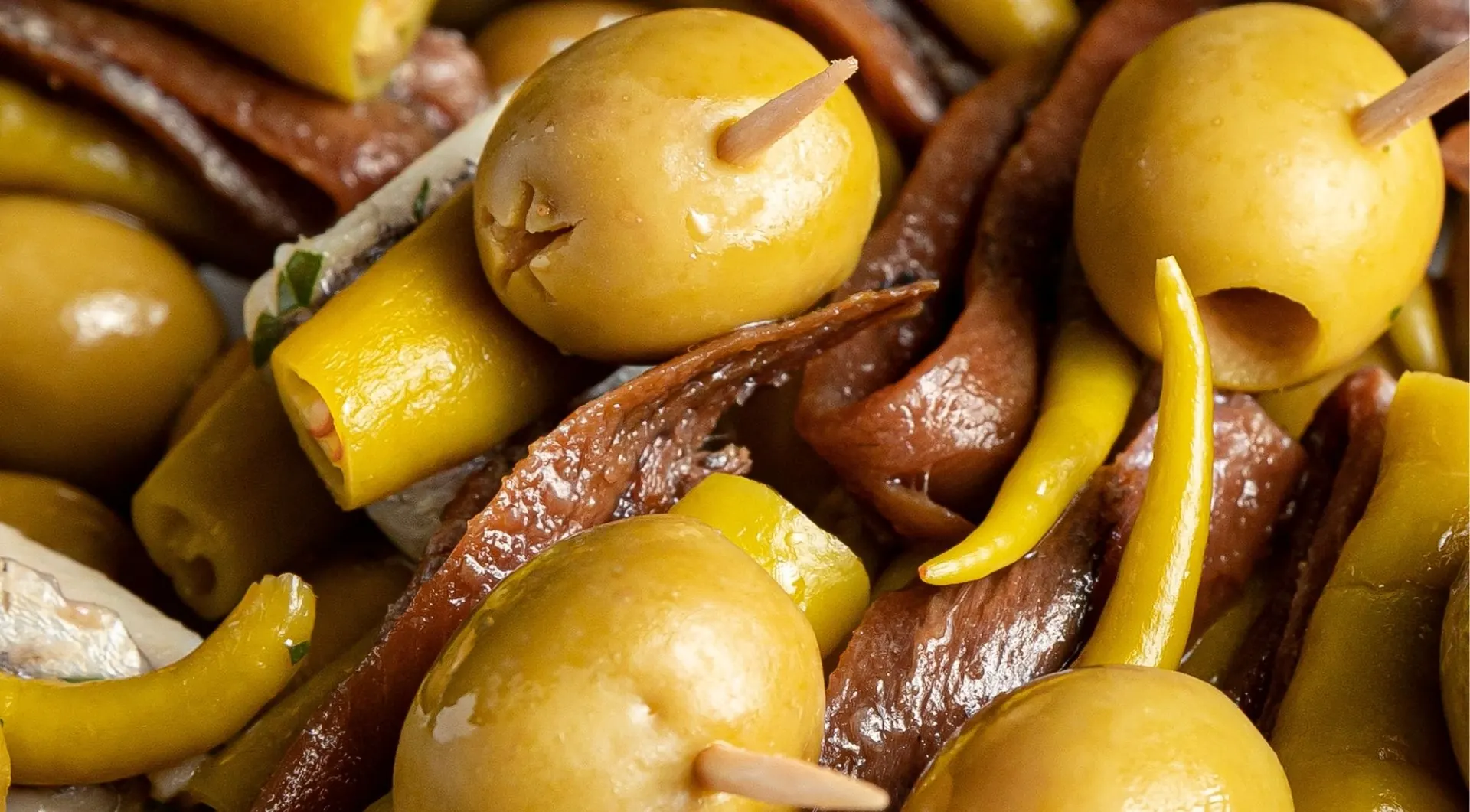
- pinchar The verb behind it
- PEEN-cho How to say it
- 1930s The first prototype
- Never free Unlike a southern tapa
- tx = ch The Basque digraph
Why San Sebastián Insists on the Word Pintxo, and Why That Is Not Just Pedantry
The distinction that actually changes how you order — and the tour we recommend for learning it by doing.
The word matters because the commercial model behind it is different. A tapa in much of Spain is a small plate that may be shared and, in Granada or León, may arrive free with your drink. A pintxo is northern — the Basque Country, Navarre, La Rioja, Cantabria — and is always ordered and paid for individually, usually €3–5. It also looks different: the name comes from pinchar, to pierce, and describes the toothpick that holds a topping onto bread. The tx is Basque spelling; Castilian writes pincho and both are said PEEN-cho. Nobody will correct you for saying tapas here, but expecting a free one is the misunderstanding that actually costs you. The tour we recommend for learning this is the one where you build a pintxo yourself and pour the cider, rather than being told about them.
Highlights
- Build your own pintxo at a wine and beer shop run by a local couple
- Pour Basque cider the txotx way, from height, and find out why
- Six tastings and four pours across five family-run bars and bakeries
- Gros and the Old Town, so you see both the residential and the famous versions
- Finish at the oldest bakery in the city, baking the same recipe since 1886
What's Included
- Six pintxo and tapas tastings plus four local drink pours
- Hands-on pintxo-making at a local couple’s wine and beer shop
- Traditional Basque cider poured txotx-style
- A guided walk through Gros and the Old Town’s back streets
- A local English-speaking guide and a group of ten at most
Check Availability & Prices
Pick your date below. Instant confirmation, and free cancellation up to 24 hours before the tour.
Pintxo or Tapa: 5 Differences That Change How You Order
Where the word comes from, who pays for what, what it sits on, how you ask for it and what goes in the glass — the five things worth knowing before your first bar.
-
The word, and what it describes
Pintxo comes from the Spanish verb pinchar, to pierce, and names the toothpick or skewer that holds a topping onto a slice of bread. Tapa comes from tapar, to cover, from the story of a slice of bread laid over a glass to keep flies out. One word describes the fastening; the other describes a lid. That is not a coincidence — they are different objects.
-
Who pays, and when
The hard rule: pintxos are never free. Each one is ordered and paid for individually, usually €3–5, and you settle up once at the end rather than after each plate. The free-with-a-drink tapa belongs to parts of southern and central Spain and does not exist in the Basque Country. Visitors who arrive expecting it are the ones who feel short-changed.
-
What it sits on — usually bread, not always
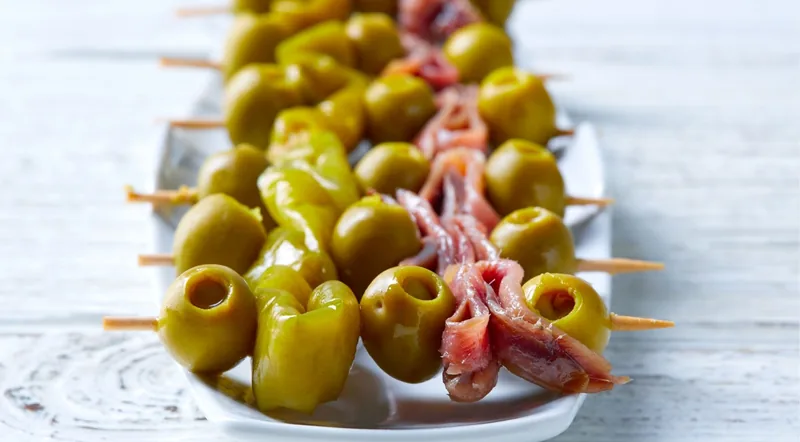
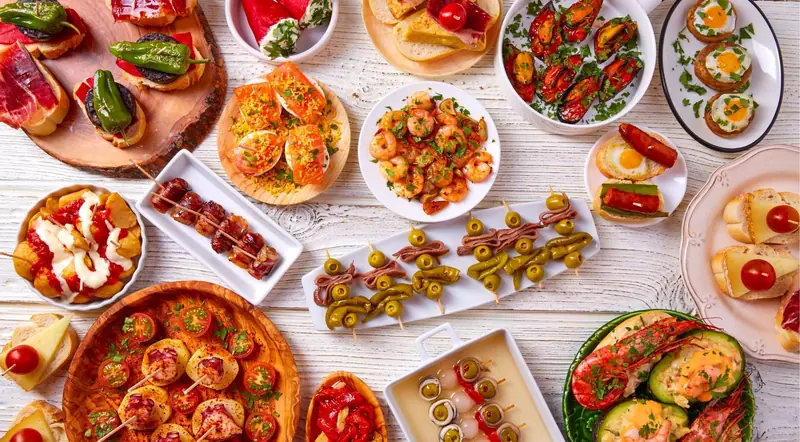
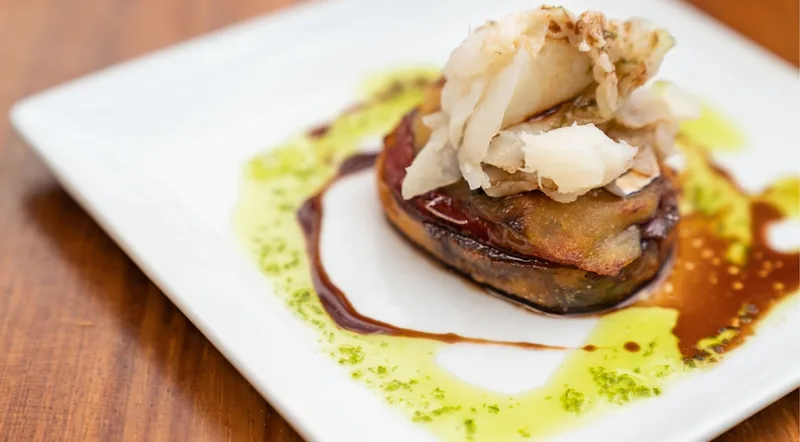
The classic format is a topping on bread with a stick through it, and most of a counter still looks like that. But the gilda has no bread at all, just anchovy, guindilla and olive on a skewer, and the hot pintxos cooked to order arrive plated: veal cheek, seared foie, hake cheeks in pil-pil, mushrooms with an egg yolk.
-
How you ask for it
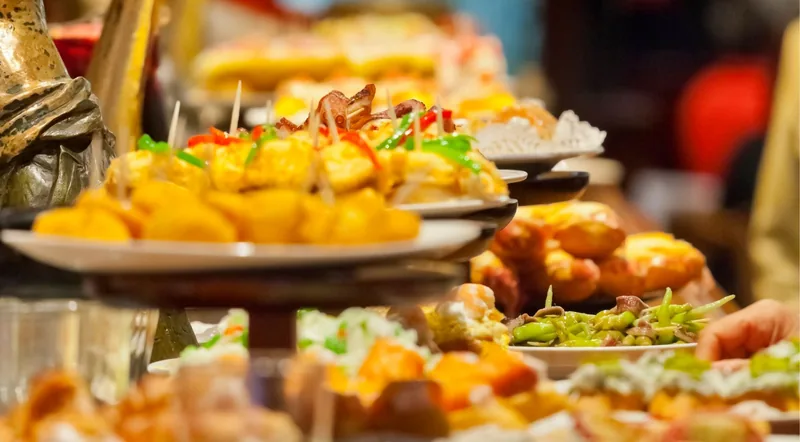
Two systems, and only one is visible. Cold pintxos are on the counter — take a plate and help yourself in traditional bars, keeping the toothpicks for the count; point and ask in busier ones. Hot pintxos are on a chalkboard: order, give your name, listen for it. One or two plates per bar, then move. Loading a big plate at the first stop is the clearest tourist tell there is.
-
What goes in the glass
Txakoli with the cured fish and the seafood — young, dry, faintly sparkling, poured from height so the spritz breaks out. A Rioja once the plates turn to meat. Natural Basque cider somewhere in the middle, poured the same way. And small measures on purpose: a zurito of beer or a txikito of wine, because you are going to four more bars.
A sagardotegi in Astigarraga where the txotx shout is not a demonstration, the txakoli vineyards above Getaria, a Basque cooking class starting in the La Bretxa market, or an Idiazábal cheese farm in the hills — four ways to go further into the vocabulary once the counter makes sense.
What Each Word Actually Looks Like
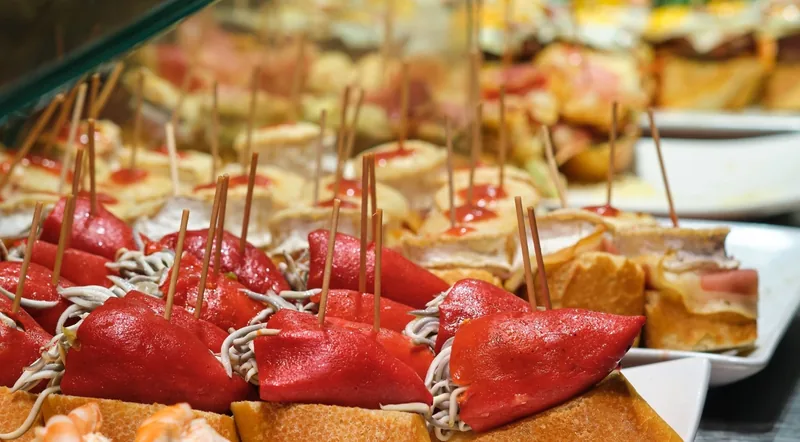
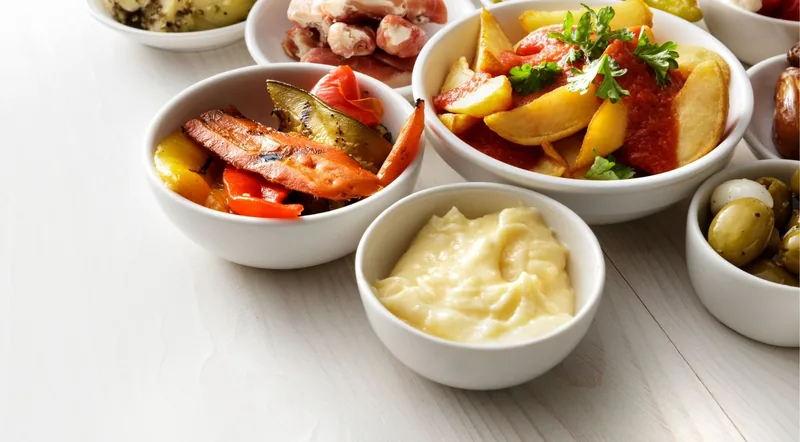
Skewers, counters, bowls and plates — the visual difference, side by side. Scroll or drag to browse.
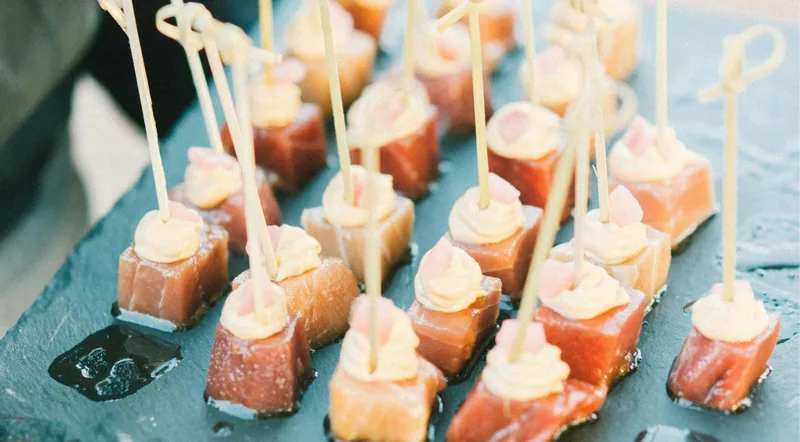
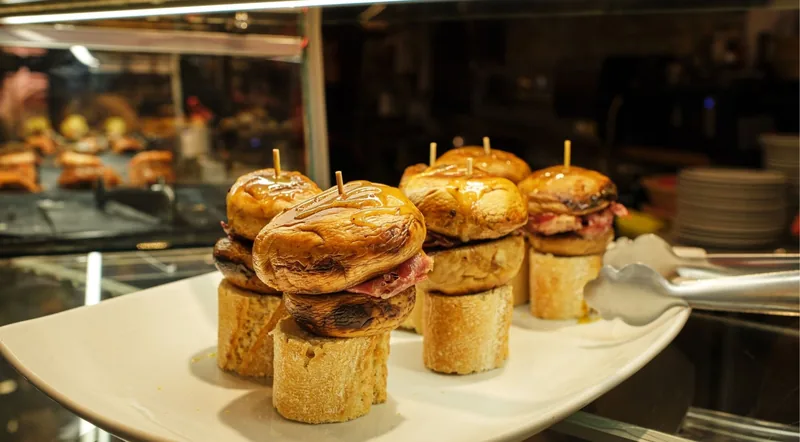
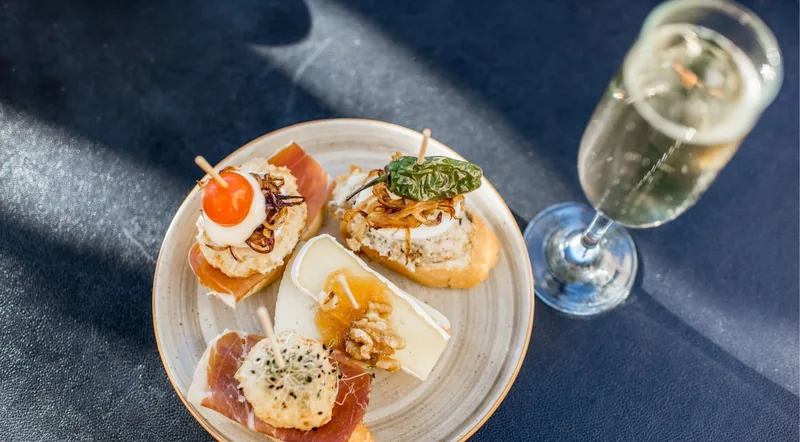
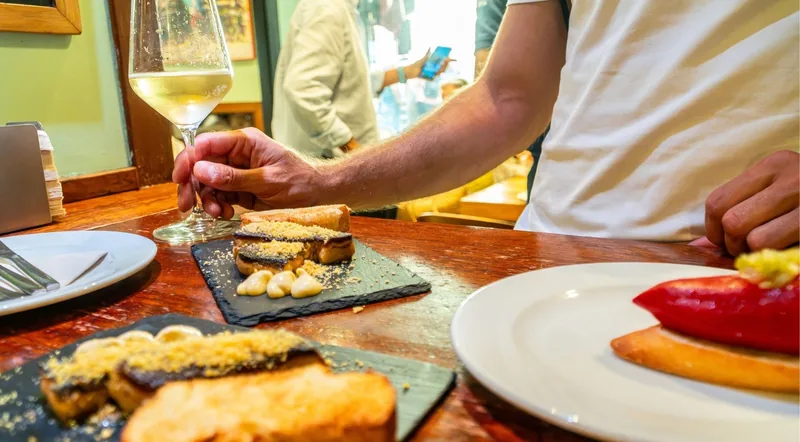
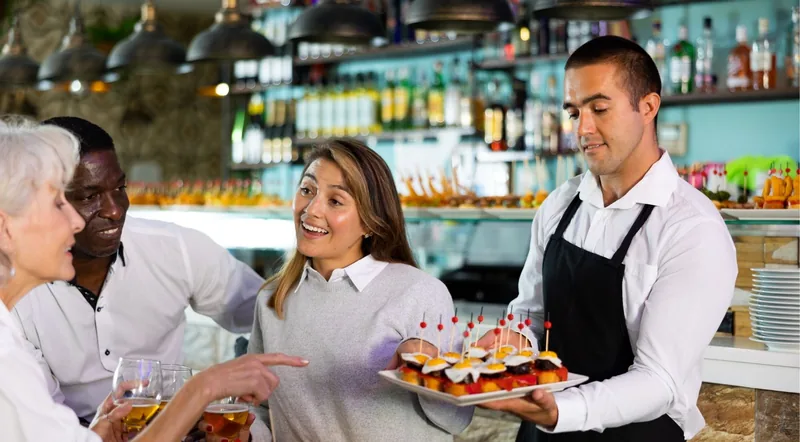
Pintxos vs Tapas: Origin, Price, Format and Region
Where each word comes from, whether either is free, what the food physically is, and which parts of Spain use which.
One word means pierce, the other means cover
Pintxo comes from pinchar, to pierce — the toothpick. Tapa comes from tapar, to cover, from the folk story of bread laid across a glass. An early Basque prototype is credited to La Espiga in San Sebastián in the 1930s: bread, a topping, a toothpick, popularised by local aristocrats. The gilda followed at Casa Vallés in the late 1940s.
A pintxo is never free; a tapa sometimes is
This is the difference that costs money. Pintxos are always ordered and paid for individually, €3–5 apiece, settled at the end. In parts of southern and central Spain a tapa comes free with a drink, which is where the expectation comes from. It has never been the practice in the Basque Country and it is not going to start.
Individually portioned, more elaborate, one bite
Tapas have no fixed format and are often shared from the middle of a table. A pintxo is a single portion built for one person, and in San Sebastián it has been pushed a long way — annual pintxo competitions, bars whose whole menu is cooked to order, chefs trained in Michelin kitchens working at bar counters. The phrase locals use is miniature haute cuisine.
Northern versus everywhere
Pintxos belong to the Basque Country, Navarre, La Rioja and Cantabria. Tapas is the term across the rest of Spain and, outside it, has become the catch-all for any Spanish small plate. The same item can genuinely be a pincho in one region and a tapa in another. What does not happen is a Basque bar calling its pintxos tapas.
Pintxos vs Tapas Compared: Word, Price, Format, Region and How You Order
Six rows that settle the difference, and one line on where the two genuinely overlap.
| Pintxo | Tapa | |
|---|---|---|
| Where the word comes from | pinchar, to pierce — the toothpick or skewer | tapar, to cover — bread laid over a glass |
| Region | Basque Country, Navarre, La Rioja, Cantabria | Across Spain, and the export term worldwide |
| Price | Always paid for, €3–5 each | Sometimes free with a drink in parts of the south |
| Format | One portion, one person, often on bread with a stick | No fixed format, frequently shared |
| How you order | Cold from the counter, hot from a chalkboard; pay at the end | Usually ordered from a menu, paid per round |
| Spelling | pintxo in Basque, pincho in Castilian — both PEEN-cho | tapa, plural tapas |
Where they overlap: the same item can be a pincho in one Spanish region and a tapa in another, and the two words are genuinely interchangeable in plenty of the country. The Basque Country is where they are not. Use pintxo here, and expect to pay for every one.
What Travellers Say About the Beyond-Pintxos Tour
Four verbatim reviews of the Eating Europe route through Gros and the Old Town.
“I can only recommend this tour. Inés was a fantastic guide, so dedicated and brilliant at getting the group to engage with each other. She gave us a fantastic insight into the food culture, what it's like to live locally in San Sebastian and not least into the history of the city and the Basque Country.”Lars · Denmark · June 2026
“Iri was outstanding. The tour was excellent and Iri’s passion for local business meant we had a really customised experience, not just hitting the tourist hotspots.”Kat · June 2026
“The pintxos and the traditional cake we ate on the tour were exceptional. We especially like the cider house and wish we could return to participate in the annual festival!”Cindy · June 2026
“Alaia was super nice, more than able to answer all our questions, and took so much time to show us “her” city.”Barbara · August 2026
Reviews are quoted verbatim from GetYourGuide. The rating reflects 17 verified reviews as of 13 October 2026, with value for money scored 4.8 — the highest of any tour on this site, and a small sample. We earn a commission if you book through the links on this page, which does not change your price.
Tours That Teach the Rest: The Gilda, the Counter, the Cider and the Cheesecake
Tours that go beyond the word and into the food. The full ranking is in our San Sebastián pintxos tours comparison.
From the gilda onwards
The market, the olive merchant and the origin of the gilda
Three hours that start among the market stalls with a ham tasting, stop at an olive and olive-oil merchant ranked among the world’s best to taste the components of a gilda separately, then work through the Old Town from the oldest counter classics to the most avant-garde plates. Rated 5.0 across 134 reviews.
Choose this if the history of the food is the part you find interesting.
★ 5.0 · 100+ reviews · From $168 · Earra Tours Check dates & prices
The classic five bars
Txepetxa for the anchovies, La Viña for the cheesecake
Eight pintxos and four drinks across five family-run Old Town bars, with the cider poured from height and a go at doing it yourself. The gilda story gets told at the right bar, and the marinated anchovies at Bar Txepetxa are the single best argument against anyone who thinks they do not like anchovies. Guides rated a straight 5.0.
Choose this if you want the canonical route with the best-rated guides in the city.
★ 4.8 · 600+ reviews · From $120 · Devour Tours Check dates & prices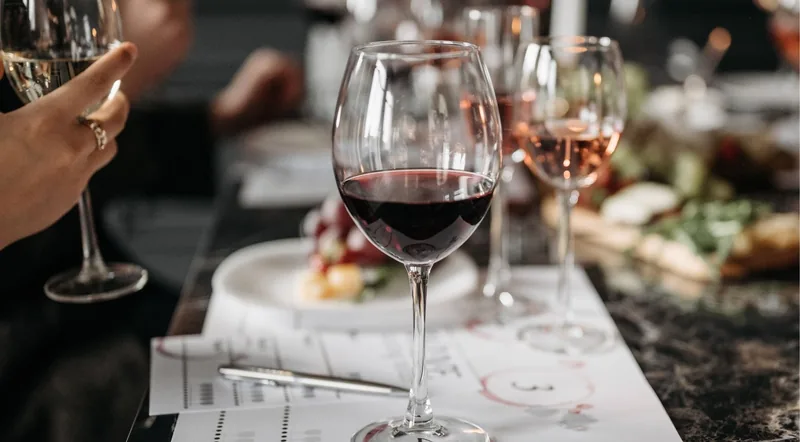 Where txotx comes from
A cider house, the barrel and the shout
Four hours at a working sagardotegi in the Astigarraga valley: the cellar, the apple orchards, and the moment someone calls txotx and the room lines up with tilted glasses. The fixed menu that goes with it — cod omelette, salt cod, an aged beef chop, cheese with quince and walnuts — is the Basque table at its most traditional.
Choose this if the drinking ritual is the bit you want to understand.
★ 4.9 · 100+ reviews · From $96 · Gipuzkoa cider houses Check dates & prices
Make them yourself
A Basque cooking class: pintxos and a tortilla, from scratch
Two and a half hours in a family-run restaurant kitchen with a local chef, cooking a four-dish Basque menu including pintxos and a tortilla, then eating it with wine and cider pairings. Groups of ten or fewer. Recipes and an apron come home with you, which is the point at which the vocabulary stops being theoretical.
Choose this if you would rather learn the format by building it than by being told.
★ 4.8 · 100+ reviews · From $161 · Devour Tours Check dates & pricesSpeaking Pintxo: Pronunciation, the Eight Dishes to Know, and the Etiquette
How to say the words, what to order at each bar, and the small rules that mark you out as a first-timer — checked 7 September 2026.
Pronunciation, in one paragraph
The Basque digraph tx is the ch of church. So pintxo is PEEN-cho, pintxos is PEEN-chos, and the Castilian spelling pincho sounds exactly the same. Txakoli, the local white wine, is CHA-ko-lee. Txangurro, the spider crab, is chan-GOO-ro. Txikiteo, the bar crawl itself, is chee-kee-TAY-oh, and a txikito is the small glass of wine you drink on one. Txotx, the shout when a cider barrel is tapped, is roughly choach. Two words that will earn you goodwill and take ten seconds to learn: kaixo (KAI-sho), hello, and eskerrik asko, thank you.
The eight dishes worth knowing by name
The gilda: anchovy, guindilla pepper and olive on a stick, created at Casa Vallés in the late 1940s and named after the Rita Hayworth film. Txangurro: spider crab, often as a warm tartlet, and Ganbara’s is the famous one. Bacalao: salt cod, in a dozen forms. Tortilla de patatas: the potato omelette, and Bar Néstor makes two a day around 13:00 and 20:00 with a name-list ritual attached. Kokotxas: hake cheeks, usually in pil-pil. Foie a la plancha: seared duck liver, one of the standard hot pintxos. Anchoas: marinated anchovies, served a dozen ways at Bar Txepetxa. And the burnt Basque cheesecake, created at La Viña in the late 1980s, crustless, caramelised and now copied worldwide. Our Old Town guide maps these to bars.
The etiquette, and the four mistakes
One: do not load a big plate at the first bar. One or two pintxos and a small drink, then leave — that rhythm is the whole structure and it is why the small measures exist. Two: do not sit down and wait for table service; most of this happens standing at a counter and seats are not guaranteed. Three: do not try to pay after every item — you settle once, at the end, on an honour system, and in traditional bars the staff count your toothpicks. Four: state an allergy before you order rather than judging a pintxo by looking at it, because bread is under almost everything and cross-contact at a busy counter is likely. One more piece of folklore worth flagging: the tradition of dropping crumpled napkins on the floor to show a bar is busy is real but fading — most bars now have bins, and several local guides say the floor version is now more tourist trope than current practice.
What this means for booking a tour
None of the above is hard, and that is the honest point of this page: once you know that pintxos are paid for individually, that the good ones are on a chalkboard, and that you settle at the end, you can eat well here without booking anything for roughly €35–45 a night. What a guided crawl adds is the route through roughly 180 Old Town bars, each strong at one dish, and someone who can get served at a counter three deep. That is worth paying for on a first evening and not on a third — our worth-it page works the arithmetic through in full, and the pintxos tours comparison ranks the routes if you decide to book. If you are still just planning, what to expect on a food tour covers the format itself.
Pintxos vs Tapas: Frequently Asked Questions
Whether they are the same, why the Basque word, how to say it, bread, whether they are free, ordering, drinks and the gilda.
Are pintxos the same as tapas?
Not quite. A pintxo is the northern, mostly Basque version: individually portioned, usually more elaborate, always ordered and paid for one at a time. A tapa is the broader Spanish term for a small plate, often shared, and in parts of southern and central Spain it arrives free with a drink. The same item can be called a pincho in one region and a tapa in another — but in the Basque Country they are never called tapas.
Why does San Sebastian say pintxos and not tapas?
Because pintxo is the Basque spelling and the Basque word. It comes from the Spanish pinchar, to pierce, and describes the toothpick or skewer that holds a topping onto bread. Castilian spells it pincho; Basque uses the tx digraph. Calling them tapas in San Sebastian is not an error anyone will correct you for, but locals do notice, and the distinction is a real one about how the food is sold.
How do you pronounce pintxo?
PEEN-cho. The Basque tx is the same sound as the ch in church, so pintxo and pincho are pronounced identically. The plural is pintxos, PEEN-chos. Two others worth having: txakoli is CHA-ko-lee, and txangurro, the spider crab, is chan-GOO-ro. Txotx, the cider-house shout, is roughly choach.
Are pintxos always served on bread?
No, though the classic ones are. The original format is a topping held onto a slice of bread with a toothpick, and most of what sits on a counter still follows it. But the gilda — anchovy, guindilla pepper and olive — is just a skewer with no bread at all, and the hot pintxos cooked to order from a chalkboard are often served plated: veal cheek, seared foie, mushrooms with an egg yolk.
Are pintxos free with a drink?
Never in the Basque Country. Every pintxo is ordered and paid for individually, typically €3–5. The free-tapa tradition belongs to parts of southern and central Spain — Granada and León are the usual examples — and it does not exist here. Expecting one is the most common misunderstanding visitors arrive with.
How do you order pintxos in San Sebastian?
There are two systems. Cold pintxos sit on the counter: in traditional bars you take a plate and help yourself, keeping the toothpicks so the bar can count them, and in busier places you point and ask. Hot pintxos are on a chalkboard and cooked when you order — give your name and listen for it. You pay once, at the end, on trust. Order one or two per bar, then move on.
What do you drink with pintxos?
Txakoli first — the young, dry, faintly sparkling Basque white, poured from height to knock the fizz out — with anchovies and seafood. A Rioja once the plates turn to meat. Natural Basque cider somewhere in the middle. Locals order small measures on purpose: a zurito of draught beer, about 150ml, or a txikito of wine, so that four or five bars are possible.
Is a gilda a pintxo or a tapa?
A pintxo, and arguably the first modern one. Anchovy, guindilla pepper and olive on a single stick, assembled at Casa Vallés in San Sebastian in the late 1940s and named after Rita Hayworth’s film character because it was green, salty and a little spicy. Every composed Basque pintxo since descends from it, which is also why it has no bread — the skewer is the whole idea.
The Guides Behind the Recommendations
Longer answers to the questions this page could only summarise.
- Wine tasting in San SebastiánPintxos-and-wine crawls, dedicated tastings, Txakoli wineries and Rioja day trips, compared.
- Txakoli wine guideWhat Txakoli tastes like, where it is made, and whether a Getaria winery tour is worth it.
- Tapas and wine pairing guideWhat wine goes with each pintxo, dish by dish, and a 21-row pairing table.
- Best wine barsParte Vieja, Gros or Centro, and how to order like a local.
- San Sebastián pintxos toursThe classic bar crawls, ranked on group size, stops and pours.
- Every San Sebastián tapas tour comparedThe full comparison table: best overall, premium, evening, private and wine.
- What to expect on a food tourWalking, food quantity, dietary options, tipping and meeting points.
- Are the tours worth it?The honest case for booking one — and the case against.
- Old Town tapas and pintxos toursHow many bars, evening or daytime, and whether the Parte Vieja is too crowded.
- Tapas and wine toursTxakoli, Rioja, cider and vermouth — which tours include what.
- San Sebastián food toursMarkets, cooking classes, cider houses and wine days.
- Evening pintxos toursStart times, finish times, crowds and whether it replaces dinner.
- Private tapas and pintxos toursWhat a private guide costs and when it beats a small group.